

🦋 What happens when you drop the metal, potassium, on water?
Feb 25, 2023 9:54 PM
Most of us think that metals are heavy solids that will sink in water and that will expand when heated.
Potassium (K) is a metal that you should not try to heat. You may get injured if you do. K is a metal that is highly reactive and so it is dangerous to heat it.
Below is an experiment that we did in a school laboratory. Unfortunately you cannot do it at home because you cannot buy potassium.
Hold a boiling tube with clamps like in the picture below.
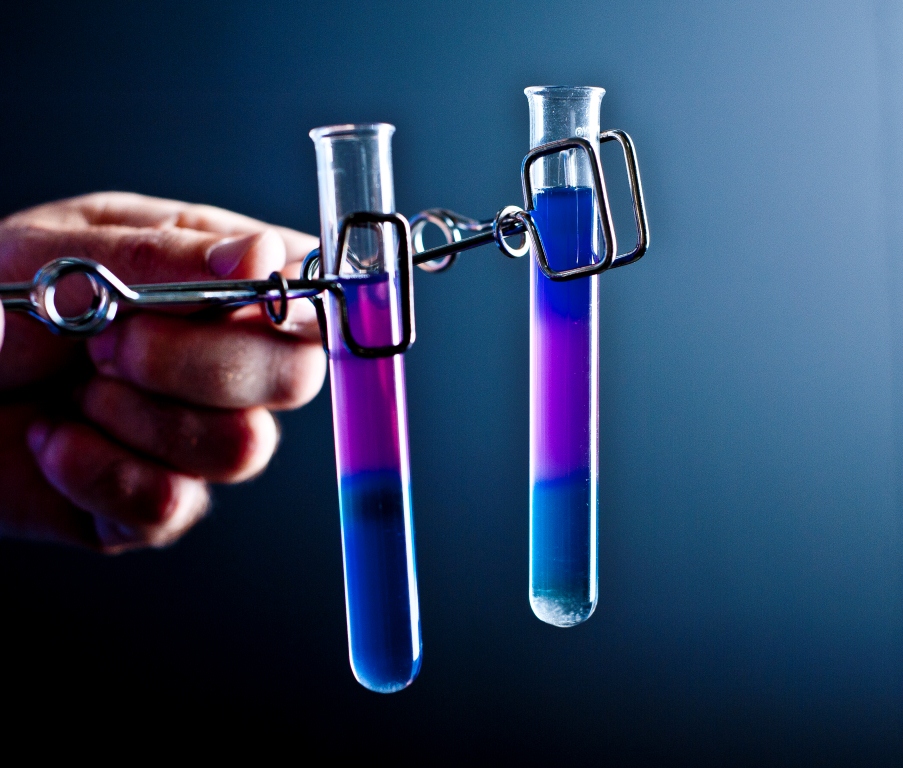
A boiling tube is a test tube that is bigger than the common test tubes. Boiling tubes are used to boil liquids in experiments and so there are clamps to hold the hot boiling tube.
Fill half the boiling tube with water. Drop a small piece of K into the boiling tube. Take a lighted wooden splinter to the mouth of the boiling tube.
Did you expect the K to sink into water like most metals will do?
I made a post comparing the orbitals of Hydrogen, Helium and Oxygen with the Solar System. The orbitals of electrons of various atoms of elements can explain how reactive that element is.
In order to achieve stable orbits of for its electrons, atoms can do 1 of 3 things:
1 ) Share electrons with other atoms using covalent bonding eg 2 hydrogen atoms bonded together in a H2 molecule
2 ) Grab electrons, making it have more electrons than protons and so become a negative ion
3 ) Give up electrons, making it have less electrons than protons and so become a positive ion.
My post on the orbitals of electrons also mentioned 3 rules for the orbitals:
1 ) Electrons like to be in pairs
2 ) Electrons like to fill up its shells
3 ) Electrons like to form Octets of 4 pairs.
A K atom has 19 electrons. The odd number of electrons means that it has 1 electron that is not part of a pair.
The electrons of K orbit in 4 shells with the electrons arranged as 2, 8, 8,1
K atoms will happily give up the odd atom in its outermost shell so as to achieve a stable 2, 8, 8 configuration. K then becomes a positive ion.
When K is dropped on water, it will react vigorously with H20 and burn at the surface of the water. Hydrogen gas is released and K becomes potassium hydroxide KOH
The reaction can be represented by the fomula:
2 K + 2 H2O -> 2 KOH + H2
When the lighted wooden splinter is brought to the mouth of the boiling tube a pop sound is heard as the hydrogen gas burns and combine with the oxygen in the air to form water H2O
The chemical fomula for the above is:
2 H2 + O2 -> 2 H20
The heat from the burning of hydrogen cause air to expand and move faster than the speed of sound. Moving faster than the speed of sound causes a sonic boom - the pop sound when the lighted wooden splinter is brought to the mouth of the boiling tube.🤣 🦋
6
Comments

Powered by RoundtableBuilt on infrastructure designed for real-time media. Learn more at RTB.io.© Roundtable 2026. By using this site you agree to the Terms of Use and Privacy Policy